How Solar Battery Storage Works
A plain-English guide to how a home battery works with your solar panels, how we size a battery for your home, and exactly what happens during a survey.
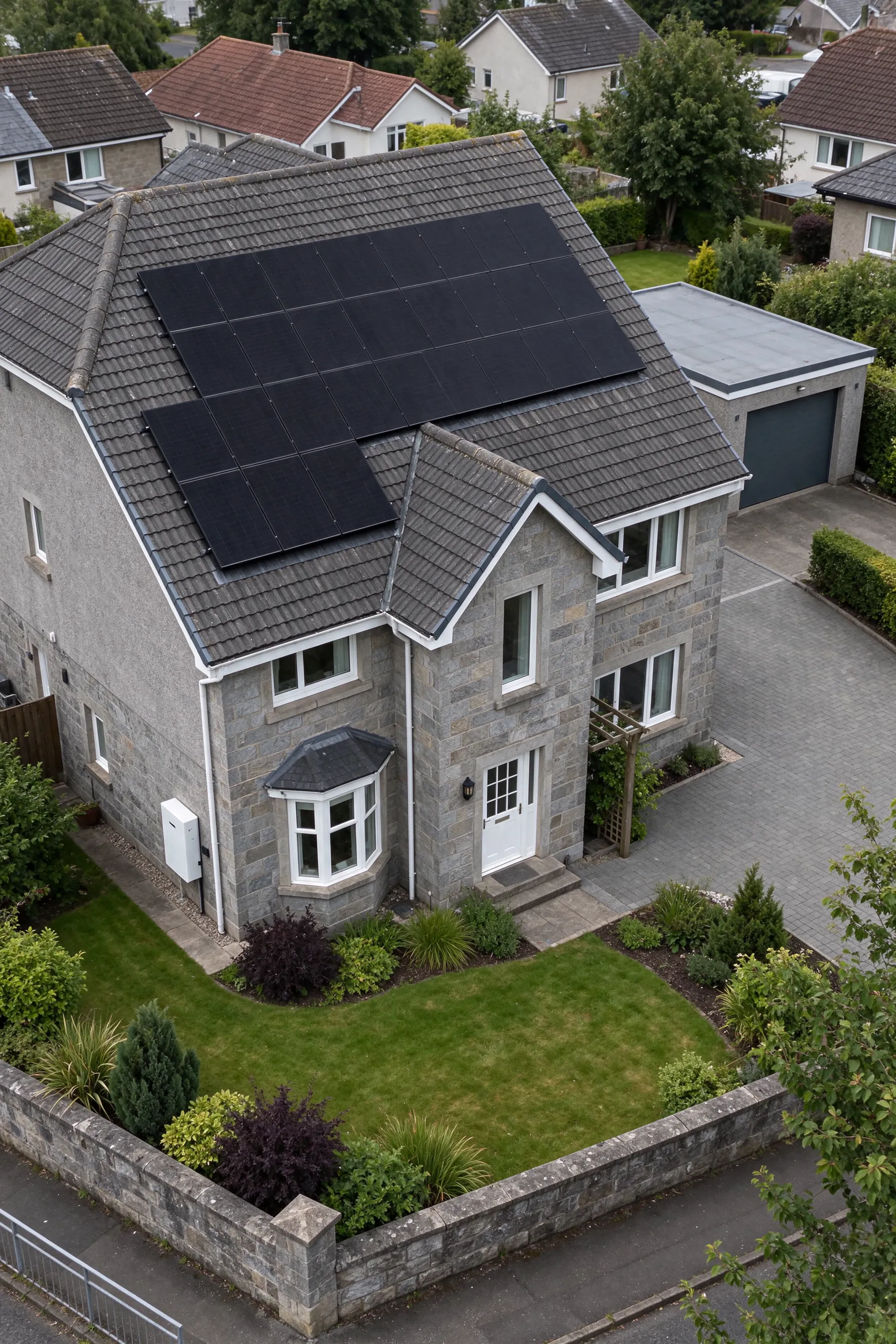
The basics: solar, battery, and your home
Solar panels on your roof generate electricity from daylight. During the day, that electricity powers your home first — your fridge, your lights, your washing machine, anything that is running. If your panels generate more than you are using, the surplus has to go somewhere. Without a battery, it flows out to the electricity grid. With a battery, that surplus is stored instead, ready for you to use later.
When the sun goes down and your panels stop generating, a home without a battery draws all of its electricity from the grid. A home with a battery draws first from the stored energy in the battery, only turning to the grid once the battery is depleted. This means you use more of the electricity your own panels have produced, and buy less from the grid.
How the pieces fit together
A typical solar-plus-battery system has four main components working together.
Solar panels
Mounted on your roof, panels convert daylight into direct current (DC) electricity. They generate whenever there is daylight — more in summer, less in winter, and most on bright, clear days.
Inverter
The inverter converts the DC electricity from your panels into the alternating current (AC) that your home uses. A hybrid inverter can also manage battery charging and discharging.
Battery
The battery stores surplus electricity from your panels during the day and releases it to your home when your panels are not generating — typically in the evening and overnight.
Consumer unit & grid
Your consumer unit (fuse box) distributes electricity around your home. The system is also connected to the grid, so you can still draw power when the battery is empty.
Sizing a battery for your home
Battery capacity is measured in kilowatt-hours (kWh). This tells you how much electricity the battery can store. A larger battery stores more of your solar surplus, but the right size depends on how much electricity you use and how much your panels generate — a battery that is too large will never fill up, while one that is too small will fill and empty quickly, wasting surplus generation.
How we work out the right size
During your survey we look at:
- Your typical daily electricity use — how much your household consumes in a day, and when. Evening and overnight use is particularly relevant because that is when the battery is most useful.
- Your solar panel output — the size of your existing array (or the array we are planning), its orientation and angle, and any shading. This tells us how much surplus you are likely to generate.
- Your household routine — whether you are home during the day or mostly in the evening, and which appliances you run and when.
- Future plans — whether you expect your electricity use to increase, for example if you are planning to switch to an electric vehicle or a heat pump.
As a rough guide, most Scottish homes with a typical solar array benefit from a battery in the 5–15 kWh range, but the right size for you may fall outside this. The survey gives a specific recommendation based on your actual usage and generation.
What happens during a survey
A survey is a visit to your home to assess your property and energy use. There is no obligation at any point.
We book a convenient time
After you submit the form, we contact you to arrange a survey at a time that suits. Surveys are carried out across Scotland.
Assessment of your roof and panels
If you have existing solar, we inspect the array, inverter and wiring. If you do not yet have solar, we assess your roof for a combined solar-plus-battery installation.
Review of your energy use
We look at your electricity usage — ideally a recent bill or your smart meter data — to understand how much you use and when, so we can recommend the right battery size.
Check of your electrical setup
We inspect your consumer unit and wiring to confirm what electrical work, if any, is needed to accommodate a battery safely.
Written quote with finance example
You receive an itemised written quote, with a representative finance example where applicable. Interest-free credit up to £30,000 is available, subject to status and affordability. Terms and conditions apply. You take as long as you need to decide — there is no pressure and no obligation.
Installation by our MCS-certified partner
If you decide to go ahead, installation is carried out by our MCS-certified partner. Most installations are completed within a day or two, depending on the scope of the work.
Battery storage with existing solar
If you already have solar panels, adding a battery is one of the most effective upgrades you can make. Most existing solar installations in Scotland can be retrofitted with a battery, though the approach depends on your current equipment.
AC-coupled batteries
If your existing inverter is not battery-compatible, an AC-coupled battery can be installed alongside it. The battery has its own built-in inverter and connects to your consumer unit independently. This is often the simplest retrofit option.
Hybrid inverters
If your existing inverter is due for replacement, or you are installing solar for the first time, a hybrid inverter manages both solar generation and battery charging in a single unit. This is generally the most efficient setup for new installations.
During the survey we check your current inverter, its age and capabilities, and recommend the most suitable approach for your home.
Book your no-obligation survey
Find out what size battery suits your home and get a written quote with a representative finance example. Interest-free credit up to £30,000, subject to status.
Request your surveyFrequently asked questions
What is a solar battery and how does it work?
A solar battery stores the surplus electricity your solar panels generate during the day so you can use it in the evening, overnight, or whenever your panels are not producing enough. Without a battery, surplus generation flows out to the grid; with a battery, it stays in your home for you to use later.
Can I add a battery to my existing solar panels?
In most cases, yes. A battery can be retrofitted to most existing solar installations in Scotland. During your survey we check your current inverter and wiring to confirm compatibility and recommend the most suitable approach — either an AC-coupled battery that works alongside your existing inverter, or a hybrid inverter if an upgrade is appropriate.
What size battery do I need for my home?
The right size depends on how much electricity you use, when you use it, and how much your panels generate. Most Scottish homes benefit from a battery in the 5–15 kWh range, but your surveyor will recommend a specific size based on your actual usage and generation. A battery that is too large will never fill up, while one that is too small will waste surplus generation.
How long does a solar battery last?
Most modern home batteries are designed to last 10–15 years or more, with warranties that typically cover a set number of cycles or a period of years. The specific warranty for your battery is included in your written quote. Battery performance does gradually reduce over time, as with any rechargeable battery.
Last updated: 30 October 2026 · Reviewed by the Scottish Energy Efficiency team